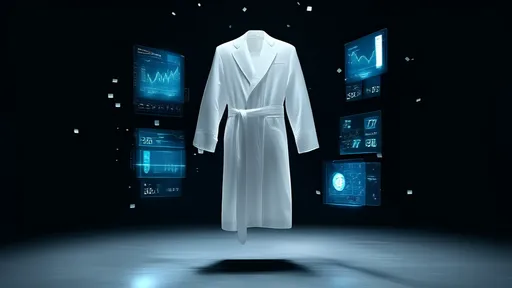
In the ever-evolving landscape of fashion, where trends come and go with the seasons, a surprising contender has emerged as the most coveted item of 2025: the undyed, pure white linen robe. This seemingly simple garment has captured the imagination of designers, influencers, and consumers alike, becoming a symbol of both luxury and sustainability in an industry often criticized for its excesses.
The rise of the white linen robe speaks volumes about the shifting priorities of the modern consumer. In a world increasingly aware of the environmental impact of fast fashion, this piece represents a return to basics—a rejection of the synthetic, the disposable, and the overly processed. Its value lies not in intricate embellishments or bold colors, but in its purity, its authenticity, and its connection to ancient traditions of craftsmanship.
What makes this humble garment so special? The answer lies in its perfect storm of rarity, sustainability, and cultural resonance. The finest linen comes from specific regions where the flax plant thrives under optimal conditions, and the process of creating the fabric without any dyes requires extraordinary skill. Each robe tells a story of careful cultivation, traditional weaving techniques, and a commitment to preserving methods that have been passed down through generations.
Fashion historians point to this phenomenon as part of a broader "anti-fashion" movement that has been gaining momentum. Where once luxury was defined by ostentation—think logo-mania and conspicuous consumption—today's elite are seeking something different. The white linen robe offers quiet luxury, the kind that doesn't shout but rather whispers its value to those who understand its significance.
The production process itself contributes to the garment's exclusivity. Unlike mass-produced clothing that can be churned out by the thousands in a matter of days, these robes take months to create. From the harvesting of the flax plants to the natural bleaching process that gives the fabric its luminous white hue, every step is carefully monitored by artisans who view their work as a form of preservation as much as production.
Celebrities and style icons have been early adopters of this trend, often pairing the robe with equally minimalist accessories or wearing it as a standalone statement piece. Its versatility is part of its appeal—it can be dressed up or down, worn as beach cover-up or as an elegant evening garment, making it the ultimate in sustainable luxury. The fact that it improves with age, developing a unique patina and softness over time, only adds to its allure.
Designers have taken note of this shift in consumer preferences. Many high-end fashion houses that once competed to create the most elaborate, eye-catching pieces are now investing in research to perfect their own versions of the white linen robe. Some are experimenting with different weaves and weights of linen, while others focus on subtle variations in cut and drape. The competition to create the definitive version of this simple garment has become surprisingly fierce.
The cultural moment is ripe for this kind of fashion revolution. After years of social media-driven maximalism, where outfits were created specifically to "pop" on small screens, there's a growing appetite for clothing that feels real, that has texture and substance. The white linen robe satisfies this desire perfectly—it photographs beautifully precisely because of its simplicity, its wrinkles and folds telling a story of human wear rather than artificial perfection.
Economic factors have also played a role in the robe's ascent to must-have status. As global supply chains continue to face disruptions and the true cost of cheap labor becomes increasingly untenable, consumers are willing to pay premium prices for items that are ethically produced and built to last. The white linen robe, with its artisanal production methods and timeless design, represents an antidote to the throwaway culture that has dominated fashion for decades.
Perhaps most interesting is how this trend has blurred traditional boundaries in the fashion world. The same robe might be worn by a Silicon Valley tech executive, a Parisian artist, and a Japanese minimalist—each interpreting it in their own way but united in their appreciation of its essential qualities. In an era of polarization, the white linen robe has become something of a unifying symbol, transcending demographics and personal styles.
As we look toward the future of fashion, the white linen robe serves as a powerful reminder that sometimes less truly is more. Its dominance in 2025 suggests that consumers are ready for a new definition of luxury—one that values substance over surface, authenticity over artifice, and timelessness over trendiness. In a world that often feels chaotic and uncertain, there's profound comfort in clothing that connects us to tradition while pointing toward a more sustainable future.
The story of the white linen robe is still being written, but one thing is clear: this is no passing fad. It represents a fundamental shift in how we think about what we wear and why we wear it. As other industries grapple with questions of sustainability and ethical production, fashion may have found its perfect ambassador in this simple, beautiful, and profoundly meaningful garment.
By /Aug 18, 2025

By /Aug 18, 2025

By /Aug 18, 2025
By /Aug 18, 2025

By /Aug 18, 2025

By /Aug 18, 2025
By /Aug 18, 2025
By /Aug 18, 2025
By /Aug 18, 2025

By /Aug 18, 2025
By /Aug 18, 2025
By /Aug 18, 2025
By /Aug 18, 2025
By /Aug 18, 2025

By /Aug 18, 2025
By /Aug 18, 2025

By /Aug 18, 2025
By /Aug 18, 2025
By /Aug 18, 2025

By /Aug 18, 2025
