In a world where sensory experiences often remain distinct, a growing community of synesthetes is blurring the lines between taste and vision. These individuals—known as taste-visual synesthetes—experience flavors as colors, textures, and even patterns. For them, the tang of lemon isn’t just sour; it might manifest as a burst of vibrant yellow or a jagged, electric shape. This unique neurological phenomenon has inspired an avant-garde movement in fashion: wearable art that translates the essence of sweet, sour, bitter, and spicy into tangible, visual designs.
The concept of dressing according to taste isn’t merely metaphorical for these designers and wearers. It’s a literal translation of sensory cross-wiring. Imagine a dress that embodies the sharpness of chili peppers—flaming red hues melting into smoky oranges, fabrics that mimic the prickling heat on the tongue. Or a suit that captures the melancholy of dark chocolate, with rich brown velvets and unexpected bitter-green accents. This isn’t just clothing; it’s a synesthete’s autobiography stitched into fabric.
One pioneering designer, Lila Voss, a synesthete herself, launched a collection titled "Palette" (a portmanteau of "palate" and "palette"). Her work directly mirrors her gustatory-visual experiences. A dress from her line might feature cascading ruffles in gradient citrus shades to evoke the effervescence of lime, or a structured blazer with asymmetrical black-and-white stripes to mirror the dissonance of coffee’s bitterness. "When I taste something, I don’t just feel it—I see it," Voss explains. "Fashion is my way of making that invisible connection visible to others."
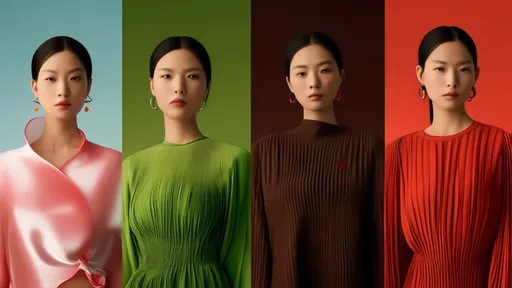
The process of creating these garments is as unconventional as the concept itself. Designers collaborate closely with synesthetes, often using detailed interviews to map out their sensory associations. A "sweet" outfit, for instance, might incorporate pastel pinks and fluffy textures based on one wearer’s perception of sugar as "cotton candy clouds." Meanwhile, another synesthete’s interpretation of sour could lead to a metallic, pleated skirt that crackles with neon highlights. The result is a wardrobe that feels intensely personal yet universally evocative.
Beyond aesthetics, this movement challenges societal norms around sensory perception. In a culture that often prioritizes uniformity, synesthetic fashion celebrates the beauty of individualized experience. A jacket that represents "umami" to one person might look entirely different to another—and that’s the point. There’s no right or wrong way to visualize taste, says neuroscientist Dr. Elena Torres, who studies synesthesia. "What’s fascinating is how these designs externalize the brain’s hidden creativity."
The trend has also sparked conversations about accessibility and inclusivity in fashion. For non-synesthetes, wearing these pieces offers a rare glimpse into a different perceptual reality. Pop-up exhibitions now invite visitors to "taste" outfits through augmented reality—pointing a smartphone at a garment might trigger a simulated flavor experience, like biting into a virtual strawberry while surrounded by its rosy, shimmering fabric counterpart. It’s a multisensory dialogue between wearer and observer.
Critics argue that such designs are overly niche, but proponents counter that all art begins as something unfamiliar. After all, as Voss puts it, "Every great fashion revolution started with someone daring to wear their inside on their outside." Whether this movement will reshape runways remains to be seen, but for now, it’s a vivid reminder that beauty—much like taste—is infinitely subjective.

By /Aug 18, 2025
By /Aug 18, 2025

By /Aug 18, 2025
By /Aug 18, 2025
By /Aug 18, 2025

By /Aug 18, 2025

By /Aug 18, 2025
By /Aug 18, 2025

By /Aug 18, 2025

By /Aug 18, 2025

By /Aug 18, 2025
By /Aug 18, 2025
By /Aug 18, 2025

By /Aug 18, 2025

By /Aug 18, 2025
By /Aug 18, 2025

By /Aug 18, 2025
By /Aug 18, 2025
By /Aug 18, 2025
By /Aug 18, 2025
