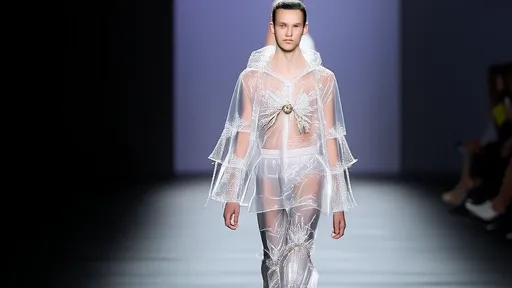
The Milan Fashion Week runway has always been a stage for the avant-garde, but this season, it served up something even more unexpected—edible fashion. Among the most talked-about pieces was a stunning sugar glass coat, worn by models who casually nibbled on it as they strutted down the catwalk. The audacious creation blurred the lines between fashion and food, leaving audiences both bewildered and captivated.
Designer Marco Visconti, the mastermind behind this sugary spectacle, described it as a "commentary on consumerism and the ephemeral nature of trends." The coat, meticulously crafted from sheets of translucent sugar, shimmered under the runway lights like a fragile armor. As models took deliberate bites, the act became a performance—an intentional destruction of the very garment they showcased. It was fashion that demanded participation, not just admiration.
The process behind the edible masterpiece was anything but simple. A team of pastry chefs collaborated with Visconti’s atelier for months, experimenting with sugar’s structural limits. The breakthrough came with a proprietary blend of isomalt and glucose, allowing the material to hold its shape without melting under intense runway lighting. Each panel was hand-poured and cooled to precise temperatures, then assembled with edible adhesive. The result? A coat that crackled with every movement, yet remained intact until the first deliberate bite.
Front-row attendees reported hearing the crisp sound of sugar breaking as models consumed portions of their outfits. Vogue’s senior critic noted, "This wasn’t just wearable art—it was performative gastronomy." The act of eating transformed the garment in real time, creating evolving silhouettes that changed throughout the show. What began as a structured cocoon coat became an asymmetrical cape, then a cropped bolero, disappearing bite by bite.
Nutritionists quickly pointed out that consuming an entire coat would be impractical—the piece contained nearly 5,000 calories—but practicality was never the point. The sugar glass coat represented fashion’s growing intersection with experiential art. Unlike traditional garments meant to last seasons, this creation celebrated transience. Its beauty lay in its impermanence, much like the fleeting attention spans of today’s trend cycles.
Social media erupted with reactions ranging from delight to disbelief. TikTok videos of the "snackable runway moment" garnered millions of views overnight, with users debating whether this marked genius or gimmick. Meanwhile, sustainability advocates praised the zero-waste concept—after the show, leftover fragments were dissolved into cocktails for the afterparty, leaving no trace behind.
Visconti’s daring experiment raises compelling questions about fashion’s future. In an industry often criticized for excess waste, could edible materials offer a delicious solution? While sugar glass may not replace wool or silk anytime soon, this Milanese moment proves that innovation often comes from unexpected fusions. The next time you admire a runway creation, you might just wonder—does it come with a side of cutlery?

By /Aug 18, 2025

By /Aug 18, 2025

By /Aug 18, 2025

By /Aug 18, 2025
By /Aug 18, 2025

By /Aug 18, 2025

By /Aug 18, 2025
By /Aug 18, 2025

By /Aug 18, 2025

By /Aug 18, 2025

By /Aug 18, 2025

By /Aug 18, 2025

By /Aug 18, 2025

By /Aug 18, 2025

By /Aug 18, 2025
By /Aug 18, 2025

By /Aug 18, 2025
By /Aug 18, 2025
By /Aug 18, 2025

By /Aug 18, 2025
